
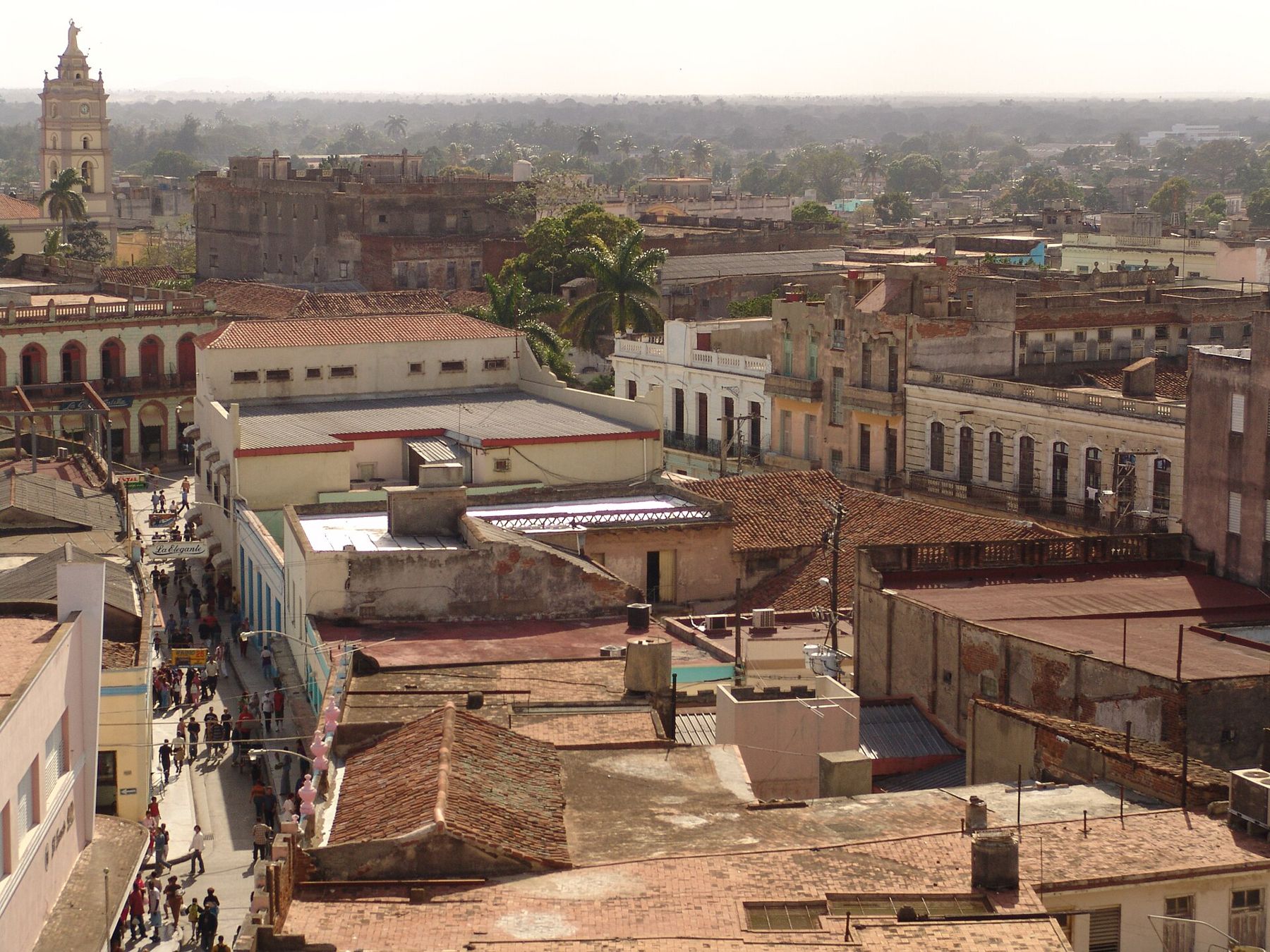
Halfway between Havana and Santiago, in the cattle country of the central plains, Camagüey is one of Cuba's largest cities and one of its least hurried. Its historic centre is a tangle of narrow streets, small squares and church towers, and it rewards anyone who walks without a fixed plan. In 2008 UNESCO listed the historic centre as a World Heritage site for its unusual street plan and its colonial buildings.
The city was founded in 1514 on the north coast, under the name Santa María del Puerto del Príncipe, and moved inland in stages to its present site by 1528. The old name survives in the people, who still call themselves principeños, and in the city's long history of cattle ranching and independence fighters.
A street plan built to confuse
Most Spanish colonial towns were laid out on a grid around a main square. Camagüey was not. Its streets curve, split into two, widen into irregular plazas and then narrow again, and many end at a church or a blank wall. The popular story says the city was built this way to confuse pirates, after the English buccaneer Henry Morgan sacked it in 1668. The likelier explanation is that the town grew without a plan, around its churches and along old paths, and that the story came later.
Either way, the effect is the same. It is very easy to get lost, and that is part of the pleasure. Carry a paper map, note a church tower to steer by, and accept that the shortest route between two points is rarely obvious. Locals are used to giving directions, and a bicitaxi, a three-wheeled pedal cab, can always carry you back to somewhere you know.
Some streets change name from one block to the next, and many people still use the old colonial names rather than the official ones, so a street sign and a local's directions may not match.
The tinajones, Camagüey's clay jars
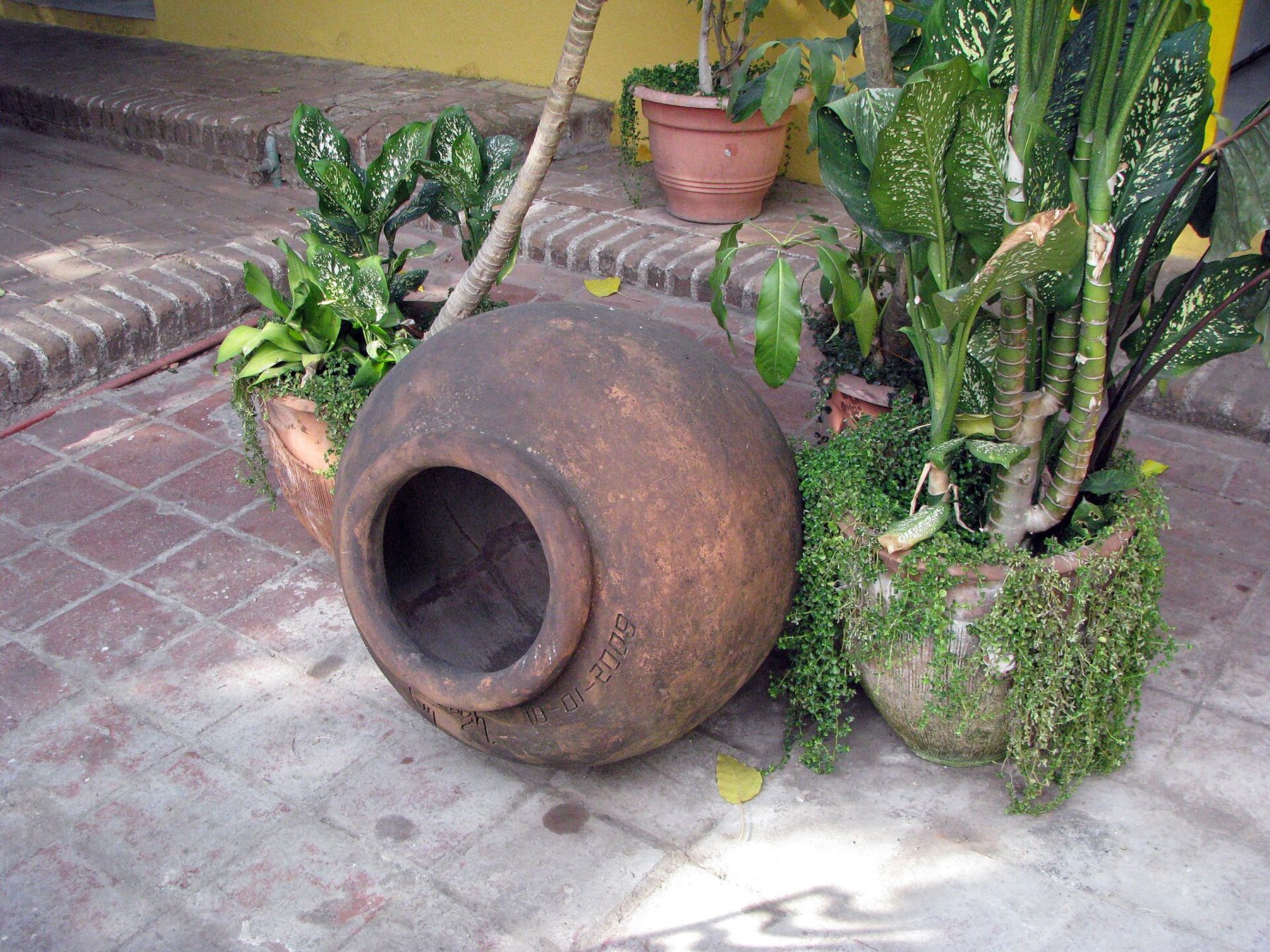
The plains around Camagüey have few rivers and long dry seasons, so for centuries the city depended on rainwater. Families collected it from their roofs in huge clay jars called tinajones, made by local potters, round-bellied and often taller than a person, and set in courtyards and gardens. The water in them was said to be cool and clean, and a household's wealth could be measured in jars.
i
Photograph by Hyppolyte de Saint-Rambert, CC BY-SA 4.0The tinajón became the symbol of the city. A local saying holds that a visitor who drinks water from one will fall in love and stay. Today the jars sit in patios, parks and museum courtyards, and you will see them everywhere once you start looking, from small decorative ones to giants half sunk into the ground. Some surviving jars date from colonial times, and local potters still make new ones in every size from souvenir to giant.
 Further along · The eastBaracoa at the end of the road
Plazas and churches
Camagüey is sometimes called the city of churches, and you are rarely out of sight of a bell tower. The cathedral, dedicated to Our Lady of Candelaria, stands on the Parque Ignacio Agramonte, the main square, named after the local landowner who led independence fighters in the region and was killed in battle in 1873. His equestrian statue stands in the middle, and the house where he was born, nearby, is now a museum.
The Plaza San Juan de Dios is the best-preserved colonial square in the city, a cobbled space framed by low houses in pastel colours, with the church and former hospital of San Juan de Dios on one side. It is especially lovely in the late afternoon. The Plaza del Carmen, further from the centre, has been restored with cobbles and a set of life-size bronze sculptures of ordinary city people, sitting, talking and reading, by a local artist. Opening hours for churches vary; Sunday mornings and early evenings are the likeliest times to find doors open.
Near the cathedral, the Plaza de los Trabajadores is one of the busiest junctions in the old city, faced by the church of La Merced, one of the oldest religious foundations in Camagüey. South of the centre, across the small Hatibonico river, the Casino Campestre is a large, shady public park where families walk and children play at weekends.
The city of Nicolás Guillén
Camagüey was the birthplace of Nicolás Guillén, born here in 1902, the poet who brought the rhythms and language of Afro-Cuban life into Cuban literature and later became the country's national poet. The city also produced the nineteenth-century writer Gertrudis Gómez de Avellaneda. Their names appear on streets, schools and cultural centres, and the city has a strong tradition of theatre and ballet.
The main shopping street, Calle Maceo, is pedestrian and busy in the daytime. Off it, quieter streets lead to small museums, galleries and workshops, including those of ceramicists who still work in clay.
Staying a while
Two days lets you walk the centre without rushing and see it at different hours. Camagüey is on the main railway line and the Carretera Central, so it is an easy stop between the centre and the east; see getting around the island for how to plan the legs. Further east, the road continues to Santiago de Cuba, and to the west are Santa Clara and the sugar towns.
Evenings in Camagüey are calmer than in the big tourist towns. Families sit out on doorsteps, the squares fill gently, and the maze becomes easier to read in the cool of the night. At festival times music and theatre spill into the plazas; dates vary, so ask locally.