
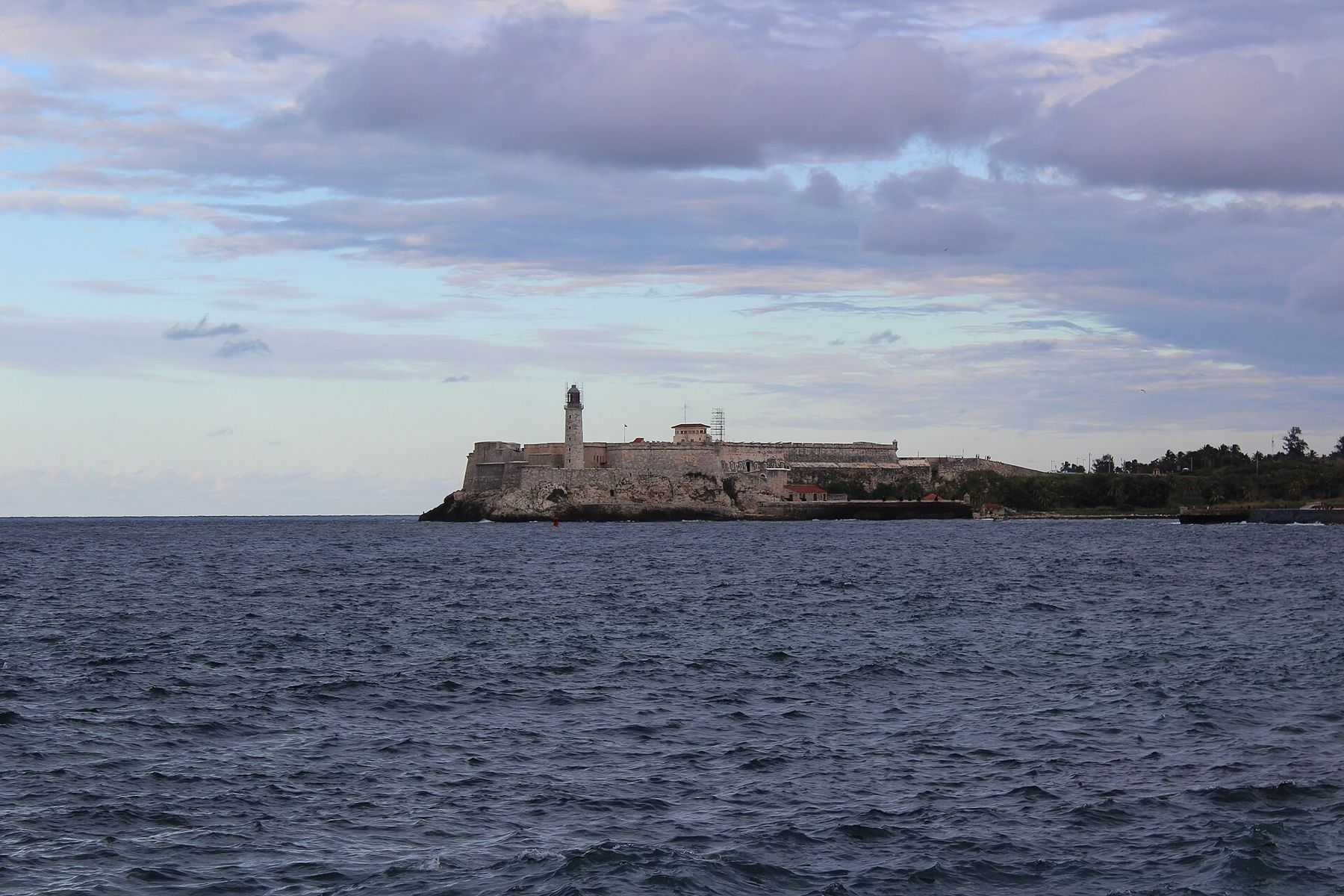
Havana exists because of its harbour: a deep, pocket-shaped bay with a narrow entrance that could be closed and defended. For three centuries, Spain's treasure fleets gathered here before crossing the Atlantic, and the city's rulers built a ring of fortresses to protect them. The two largest stand on the rocky eastern side of the harbour mouth, facing Old Havana across the channel: the Castillo de los Tres Reyes del Morro, known simply as El Morro, and the Fortaleza de San Carlos de la Cabaña.
Together they are part of the World Heritage Site of Old Havana and its fortification system, and they make one of the best half-days in the city.
El Morro, the lighthouse fort
El Morro was built in the late sixteenth and early seventeenth centuries to designs by the Italian military engineer Juan Bautista Antonelli, on the rocky headland at the harbour mouth. Its thick walls follow the shape of the rock, and from the water it seems to grow out of it. A chain was once stretched across the harbour entrance at night to Castillo de San Salvador de la Punta, the smaller fort on the Old Havana side.
The lighthouse that rises from El Morro dates from the nineteenth century, and its beam is a fixture of the Havana night. Walk the ramparts for views straight down into the waves and back across to the Malecón and the city's skyline.
El Morro's great test came in 1762, during the Seven Years' War, when a British force besieged Havana. After weeks of bombardment and mining, the fort fell and the city surrendered. The British held Havana for about a year before handing it back to Spain in exchange for Florida. The shock of that loss led directly to the next project on the hill.
La Cabaña, the largest fortress
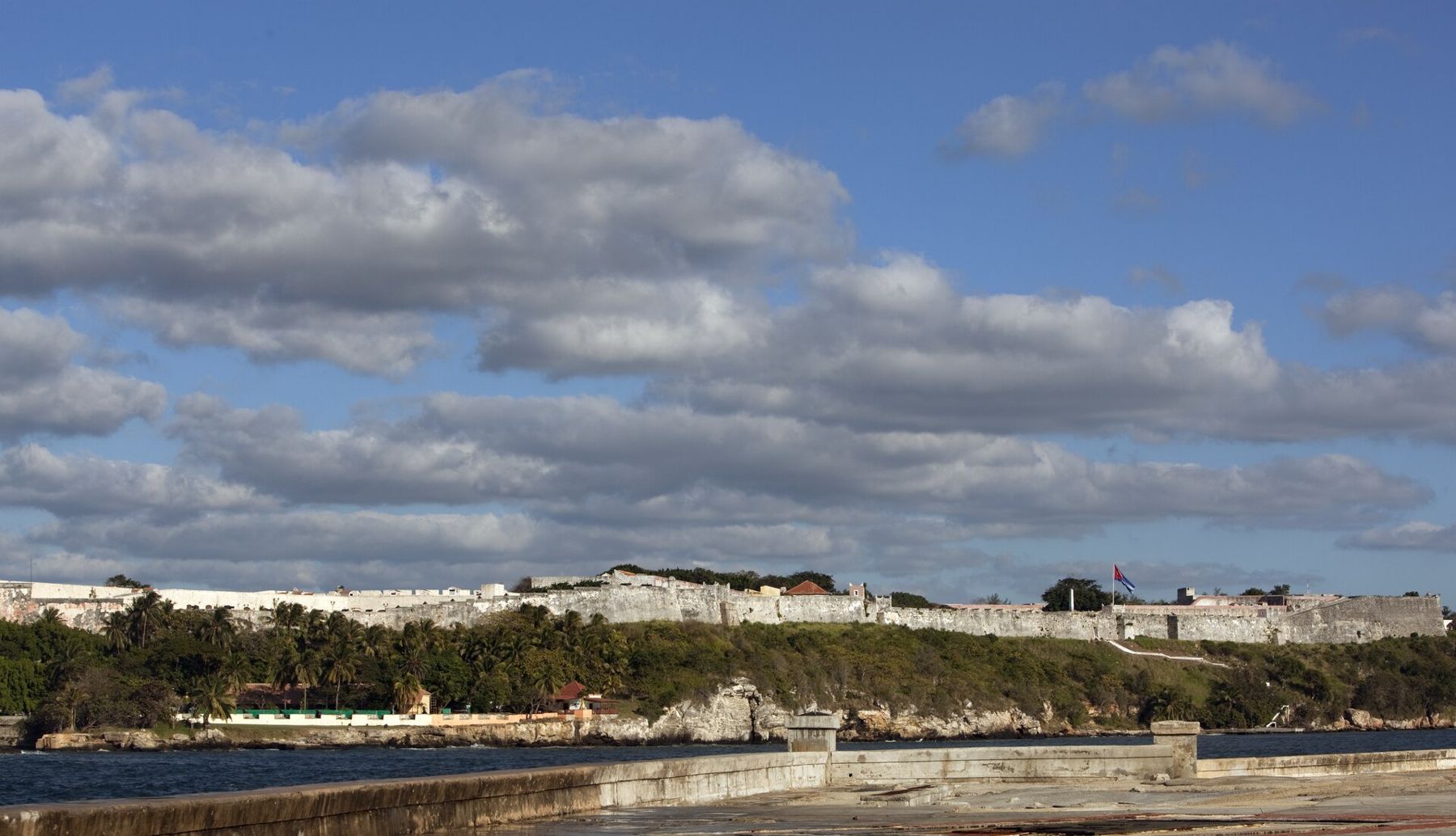
The British had attacked El Morro from the high ground behind it, so after 1763 the Spanish crown fortified that ridge. The result, completed in the 1770s, was La Cabaña, one of the largest colonial fortresses in the Americas, stretching for hundreds of metres along the hill above the harbour.
i
Photograph by Carol M. Highsmith, Public domainInside, you walk along streets of barracks, storerooms, chapels and gun emplacements. Several rooms hold museums on fortifications and weaponry. The fortress served as a military prison at various times, including during the colonial era and in the early years after the 1959 revolution, when Che Guevara set up his command here and revolutionary tribunals tried and executed officials of the previous government. That history is told in part on site; it remains painful and contested, and it is worth knowing before you go.
 Further along · HavanaOld Havana's four squares, walked slowly
The cañonazo at nine
Every evening at nine o'clock, soldiers in eighteenth-century uniforms parade through La Cabaña by torchlight, a crier calls out, and a cannon is fired over the harbour. The ceremony, the cañonazo, recalls the colonial custom of firing a gun to signal the closing of the city gates and the raising of the harbour chain. In Old Havana you will hear the boom across the water, and some habaneros still check their watches by it.
The ceremony is popular, so arrive in good time to find a place on the wall with a view. Entry at night is charged separately from daytime visits in some periods; check the current arrangements before you go. The whole thing is short, and then everyone leaves at once, so have a plan for getting back.
The Christ of Havana
On the hill just east of La Cabaña, above the small town of Casablanca, stands the Cristo de La Habana, a white marble statue of Christ about twenty metres tall, by the Cuban sculptor Jilma Madera. It was unveiled in December 1958, only days before the fall of the Batista government. The statue faces the city with one hand raised, and the terrace at its feet gives one of the widest views over the harbour, Old Havana and the whole curve of the Malecón.
You can walk between the Christ and La Cabaña in a few minutes along the ridge, so it is easy to combine them in the same afternoon.
Crossing the harbour mouth
There are two ways over. The slow, local one is the small passenger ferry from the Old Havana waterfront to Casablanca, a crossing of a few minutes that gives a low, close view of the forts. From Casablanca a path and steps climb to the Christ and La Cabaña. Ferry schedules and security checks vary, so ask at the jetty.
The quicker option is a taxi through the harbour tunnel, which opened in 1958 and runs beneath the channel from near the Malecón to the eastern shore. Taxis wait outside the forts in the evening, but agree the fare before you set off.
Doing it with soltura
- Late afternoon is best. The forts are hot at midday and the light is flat. From four o'clock onwards it softens, and the views back to the city glow at sunset.
- Do El Morro first. It sits at the tip of the headland. Walk back along the ridge to La Cabaña as the sun drops.
- Bring a torch. Paths and steps are poorly lit, and blackouts can leave the area dark.
- Cash only, usually. Fees for the forts and their museums are paid on site and change; check before you go.
From the ramparts you look straight across to the old city and the Malecón, and along the coast to the east lies the fishing village described in Finca Vigía and Cojímar, with its own small fort.